
Virtual Commissioning of Automation Systems
Aalto Factory of Future
This case study explains how Aalto University achieved Simplified Node Setup, Consistent Dataflows, Great Scalability and improved their own working collaboration, by adapting OPC UA Forge. See also how Aalto leveraged their Forge site license to other projects.
” We can confidently recommend Prosys OPC UA Forge for reliable, straightforward OPC UA integration in distributed control scenarios.” – Tuojian Lyu, Technical Lead for CloViC, Aalto Factory of the Future.
About
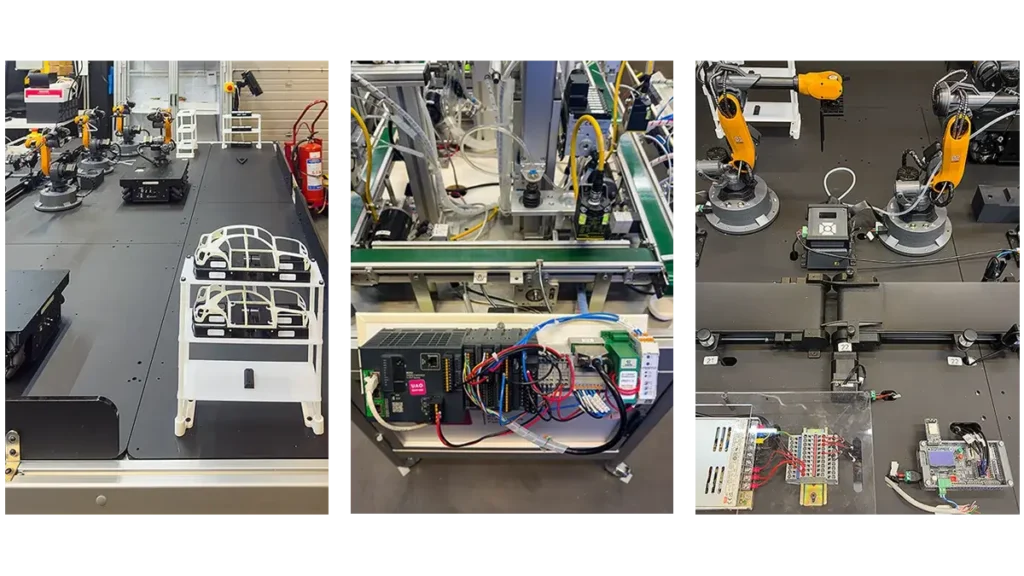
Aalto Factory of the Future (AFoF) is a laboratory and demonstration environment maintained by Aalto University’s Department of Electrical Engineering and Automation. It serves as a platform for innovation, research, and education. Within its facilities, humans, robots, and production units operate together, enabling the development of diverse technologies in the context of industrial production.
At the core of the initiative is modularity: the aim is to build flexible, intelligent production units that can adapt to changing needs and dynamically form functional systems. One of the key technologies is the IEC 61499 standard for distributed control systems, which enables component reuse, vendor independence, and event-driven operation.
Challenges
The research addresses challenges such as synchronizing I/O data from multiple controllers, ensuring deterministic real-time behavior, and integrating with external IT services, including cloud-based workflows. These challenges are tackled through containerized control runtimes, cloud orchestration, and advanced monitoring, which enable continuous improvement in both legacy and Greenfield systems.
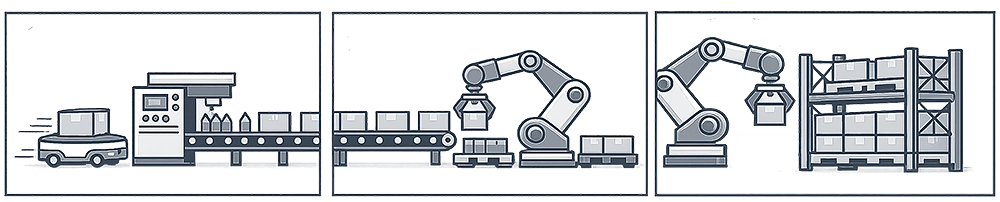
An example of AFoF in practice is the demonstration of resource-centric flexible production: in such an arrangement, an AGV robot transports workpieces to a production machine, where they are processed, and finally larger AGV carries them to storage. Control is implemented using modular capabilities and the system communicates with OPC UA and operates according to IEC 61499 standard. AFoF’s activities have also been extended into virtual environments through digital twin and simulation technologies.
Cloud-Based Virtual Commissioning Platform
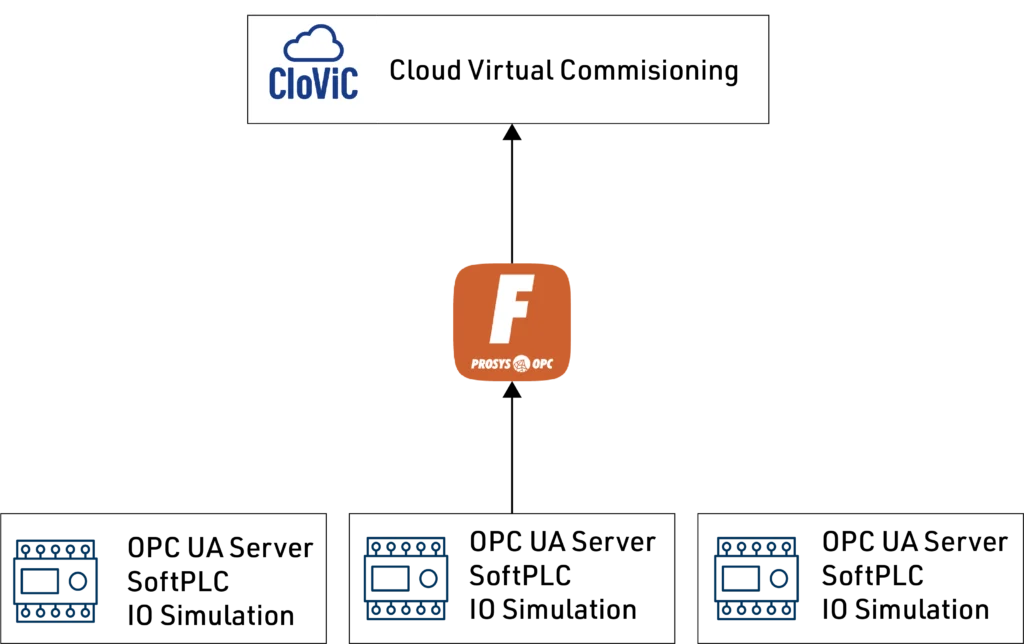
As part of Aalto Factory of the Future’s research on modular and distributed automation, the CloViC (Cloud-based Virtual Commissioning) platform represents a significant step toward cloud-native industrial control engineering. Developed within Aalto University, CloViC is a web-based environment hosted on Microsoft Azure that orchestrates containerized SoftPLC instances and provides advanced I/O simulation capabilities. It allows engineers to design, simulate, and validate IEC 61499-based control applications before deploying them to physical hardware.
CloViC streamlines the traditional commissioning process by providing real-time data visualization, analytics, and automated orchestration of control containers through Kubernetes. This cloud-native approach reduces engineering effort, enhances reliability, and accelerates development cycles. Engineers can test the behavior of distributed systems in a fully virtualized environment, ensuring that control logic is robust and consistent before it interacts with actual production equipment.
Role of OPC UA Technology
Integration of Prosys OPC UA
Forge
To maintain real-time data consistency across virtualized controllers, CloViC integrates Prosys OPC UA Forge as a core synchronization engine. Forge continuously collects and updates OPC UA node values from each containerized SoftPLC instance, ensuring that the most recent data is always available to analytics and visualization modules. This eliminates manual configuration work and prevents mismatches between nodes, greatly simplifying system management.
By embedding Prosys OPC UA Forge directly into the CloViC architecture, the platform maintains a single, authoritative source of truth for all simulation data. As a result, services—such as dashboards and performance analyzers—always operate with accurate and up-to-date information. The outcome is a highly stable simulation environment that faithfully mirrors the behavior of real control systems.
Benefits and Impact
Through its integration with Prosys OPC UA Forge and the use of OPC UA standards, CloViC achieves several key advantages:
- Simplified setup: Manual node configuration is minimized, reducing setup time and human error. Forge API allowed for Automated Node creation and time savings due to extensive API documentation.
- Consistent data flow: Real-time node synchronization ensures high-fidelity simulation without outdated or unsynchronized values thanks to Forge OPC UA server aggregation function.
- Enhanced scalability: Adding new SoftPLC containers or simulation projects remains effortless, as Forge automatically manages the node synchronization process.
- Improved collaboration: As a web-based platform, CloViC allows multiple engineers to work concurrently on control projects, facilitating shared testing and validation workflows.
Additional projects
Aalto Factory of the Future is taking full advantage of the Forge Site license and they use it in multiple Projects.
- Vertical Farm: Forge is used as the central OPC UA Server, from which custom Python script is able to get real time data from hardware OPC UA Servers.
- Water Process: After positive experiences, Forge was used as a central hub for water process management. In this system multiple servers needed read/write access and the data was transferred to a Digital Twin of the process.
- Energy Monitoring: Forge Data Logger was used to collect power consumption data from multiple PLCs from a Conveyor belt. Then Forge was connected to data visualization software to see and optimize trend data.
Get in touch with us at Prosys if you want to hear more about how Forge can help you or how other institutions and companies are using Forge!