From the model to a running system.
Once the model is ready, whether it’s yours or ours, this is where it turns into something that runs and moves data. We commission Prosys OPC UA Forge into your environment, or we back your own developers building on OPC UA. Either way the work has a defined scope, and the project stays yours.
Forge Commissioning
Industrial DataOps: Forge installed, connected and reporting.
Forge is configured, not coded, so most of the work is knowing what to configure. We do that part with you: the model, the connectors, the security, and the last stretch where the data turns into a dashboard someone actually opens.
And because we wrote the OPC UA stack underneath Forge, we’re not guessing when something misbehaves at the protocol level.
What we do
Installation and network design
Including DMZ setups where OT data has to cross a security boundary. Certificates, trust lists, and user management against LDAP or Active Directory.
Model implementation into Forge
NodeSet imports, mappings, expressions and bulk creation through the Forge API. If the model doesn’t exist yet, that’s where the project really begins: see OPC UA Information Modeling.
Protocol connectivity
Modbus, Siemens S7comm, Beckhoff ADS, EtherNet/IP and SQL sources into a single OPC UA namespace, plus aggregation of your existing OPC UA servers.
Data delivery
Logging and history to SQL, MQTT or AMQP publishing to your cloud, and server-to-server exchange where two systems need the same data under different names.
Dashboards and analytics
Grafana dashboards and Power BI reports on Forge data, including OEE and production reporting.
How it runs
Fixed scope, fixed price, agreed before we start. A typical engagement is a few days to a few weeks, not months. If it turns out to be bigger than the OPC UA layer, we’ll say so and help you scope the rest for your own team or your partner.
Developer Support
Your developers, our specification knowledge.
OPC UA is a big standard, and most teams meet it once. The parts that eat time are rarely the ones the documentation covers well: certificate handling that survives the field, session and subscription behavior under load, an information model a client can actually navigate, a device that reads the spec its own way. We work alongside your team on those parts. Your team keeps the code and the roadmap.
What we do
Architecture and code review
Of OPC UA client, server and PubSub implementations.
Security and certificate design
That holds up in deployment.
Information model implementation
Including companion specifications and code generation.
Connection, session and subscription management
And performance troubleshooting.
Interoperability testing
And hands-on certification preparation.
Pair development and mentoring
In sprints alongside your own developers.
On any stack, not just ours
We know our own SDKs best: Prosys OPC UA SDK for Java, .NET, C/C++ and Sentrol. But the expertise is in the standard, not the product. Right now we’re running a .NET engagement for an automotive supplier on a third-party OPC UA stack. If your team has already committed to another SDK, that’s not a problem. Same where OPC UA meets the IIoT side: MQTT, Sparkplug and cloud ingestion are part of the same conversation, not a separate one.
Or we write it
Sometimes a team doesn’t need support, it needs the thing built. We take those projects on our own SDKs when the work is genuinely a piece of OPC UA software: a client, a server, a PubSub application, a gateway between a protocol and an OPC UA namespace. Scoped, delivered, documented and handed over. We write OPC UA software. The field work, PLC programming and screens around it belong to your own team or your partner, and we’re glad to work underneath either.
Languages and platforms
Java, .NET/C#, C/C++, Delphi and JavaScript, primarily on Windows and Linux.
Kick-off your development
Our Solution Development service encompasses the design and development of OPC and OPC UA client, server, and PubSub applications. We serve device, machine, and system vendors, as well as end-users across diverse industries, including manufacturing, process industry, energy production, smart grids, traffic management, and many others.
Key stages of the Solution Development service
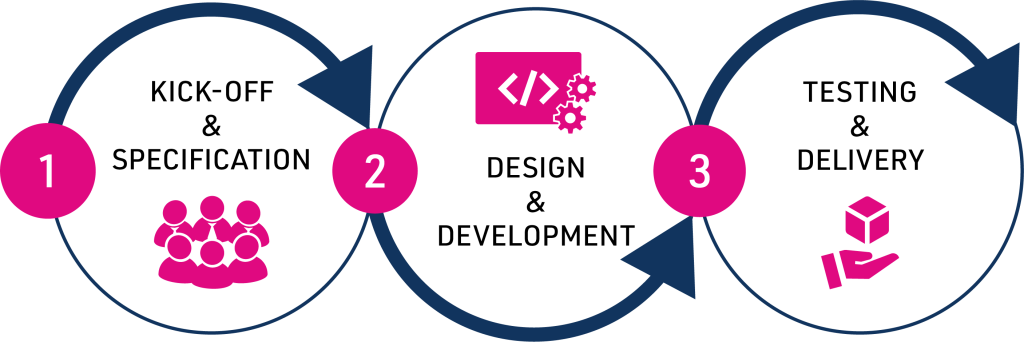
- Kick-Off & Specification. We begin by thoroughly understanding your challenges, system requirements, and desired solutions.
- Design & Development. Our team of skilled system architects and developers gets to work crafting the solution tailored to your unique requirements, ensuring the highest quality and performance.
- Testing & Delivery. We deliver the results to you, guaranteeing seamless integration into your systems. Our commitment doesn’t end here; we’ll make any necessary adjustments to ensure everything runs smoothly.
Previously designed applications for customers
- Data Acquisition
- Supervisory Control
- Production Reporting
- Quality Control
- Manufacturing Execution System
- Device Diagnostics
- Condition Monitoring
- Asset management
- Gateway / Communications
Focus on collaboration
Depending on your needs, our team utilizes, for example, Java, .NET C#, C/C++, Delphi, and JavaScript. We primarily target the Windows and Linux platforms while also supporting other platforms when required.
Focusing on enhancement and collaboration, we extend our expertise beyond our products to include partner offerings, providing a comprehensive approach to solution development.
Customer Cases

Valmet - Software applications for industrial automation
Not sure of the scope yet? Start with QuickStart.
Talk to Us About QuickStartQuickStart is a fixed-price first engagement with a defined end: we get one thing working, whether that’s a first client or server against your real system, a model that loads, or a build that runs again, and you decide from there. Price is agreed before we start.
From there, the route is yours. Your developers can carry on with us alongside them, or we can scope and build the component ourselves using our SDKs. Either way, it stays software work with a defined boundary, and the project stays yours.