OPC Day Finland 2025 - Fluently from factory to the cloud with OPC UA
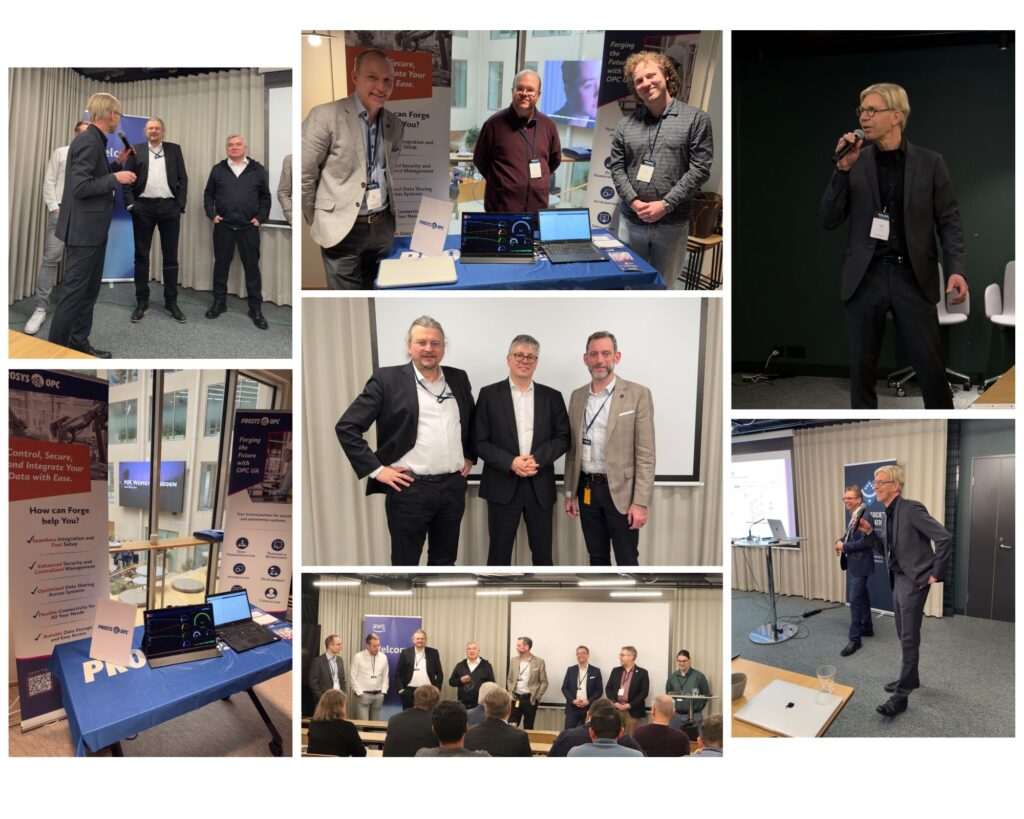
OPC Day Finland 2025 was hosted on December 10 by AWS Finland at the center of Helsinki. The venue was perfect and the room was full of new and familiar faces of experts from the local industry as well as the high level speakers around the world.
Steve Blackwell joined from US as a keynote speaker for AWS, together with Stefan Hoppe as the president of OPC Foundation. Erich Barnstedt of Microsoft together with Peter Lutz of OPC Foundation completed the group of leaders managing the direction of OPC UA vision and development. Together they covered the current status and roadmap for OPC UA, including Field Exchange (FX) and Cloud Exchange (CX).
Among them, we had Thomas Makait (MTP4Pharma) introducing Module Type Package (MTP), which is gaining traction in the pharmaceutical industry – and Arno Schmetz (Fraunhofer) introducing the Battery Passport as the first implementation of the Digital Product Passport (DPP), which is becoming compulsory for nearly all products sold in the EU market.
To complete the invited speakers, we had Timo Lundstedt and Ronal Bejarano to represent a joint project between Konecranes and Wärtsilä, two leading Finnish high tech companies, in which OPC UA is playing a key role.
The afternoon was reserved for more technical presentations from the sponsors, who were also spot on with many interesting details ranging from case studies to AI agents and even Unified Namespace (UNS), which might be considered opposite to OPC UA, but is in fact something that fits very well to the idea behind OPC UA in practice.
If you are puzzled by all that OPC UA covers, we recommend checking out the Opening Presentation by Jouni Aro, where he introduces the Finnish Society of Automation, but also gives a quick primer on the complete picture of the OPC UA landscape and targets.
Presentations
In case you missed the event or want to refresh your memory of the presentations, the Finnish Society of Automation has kindly added the recordings of each presentation to a playlist on their YouTube channel. You can also find the presentation files on their website.
Don’t have time to dive into the presentation videos right now? No worries; below, you can find short descriptions of each presentation and links to every speech.
Opening Presentation
by Jouni Aro, Finnish Society of Automation
The opening speech welcomed participants to OPC Day Finland and introduced the Finnish Society of Automation, but also gives a quick primer on the complete picture of the OPC UA landscape and targets at the end of the presentation.
Keynote 1: The Acceleration of Digital Manufacturing with Smart Machines and Software-Defined Factories
by Steve Blackwell, AWS
This keynote explored AWS’s perspective on the acceleration of digital manufacturing through smart machines and software-defined factories. It emphasized the convergence of engineering, operations, and IT, highlighting scalable cloud and edge architectures, industrial data platforms, and AI-driven use cases such as predictive maintenance. The talk showcased how manufacturers can move beyond isolated pilots to globally scalable solutions that improve reliability, flexibility, and time-to-value across diverse industrial sectors.
Keynote 2: OPC Foundation and the Trends in Digitalisation
by Stefan Hoppe, OPC Foundation
Stefan Hoppe’s keynote explored the OPC Foundation’s role in shaping industrial interoperability and the latest trends in digitalisation. It highlighted how OPC UA information models, companion specifications, and multi-stakeholder liaisons are enabling scalable, semantic, and secure data exchange across ecosystems. The talk emphasized the growing importance of data spaces and regulatory-driven initiatives such as the Digital Product Passport (DPP), outlining how OPC UA-based infrastructures can reduce integration effort while accelerating compliance and cross-company collaboration.
OPC UA Cloud Initiative including Catena-X and Digital Product Passport
by Erich Barnstedt, Microsoft
Erich Barnstedt presented the OPC UA Cloud Initiative and how it enables trusted, scalable industrial data sharing across companies and ecosystems. It highlighted cloud reference architectures and standardized OPC UA profiles designed to support interoperability from edge to cloud, while aligning with emerging regulations and compliance requirements. The talk also showcased how initiatives like Catena-X and the Digital Product Passport can leverage OPC UA information models and companion specifications to build secure, vendor-agnostic data pipelines for traceability, transparency, and cross-value-chain collaboration.
OPC UA and Battery Passport
by Arno Schmetz, Fraunhofer FFB
Arno Schmetz focused on how OPC UA can support the emerging Battery Passport requirements by enabling interoperable, structured, and trustworthy data exchange across battery production and supply chains. It highlighted the rapid growth of the battery market and the resulting need for digital compliance solutions, positioning interoperability as a core challenge. The talk outlined an approach for building an OPC UA–based interoperability layer to connect production machines and systems, making battery lifecycle and traceability data easier to standardize, share, and scale across stakeholders.
MTP in the Pharmaceutical Industry
by Thomas Makait, MTP4Pharma
In this presentation Thomas Makait explored the adoption of Module Type Package (MTP) as a foundation for modular, plug-and-produce automation in the pharmaceutical industry. It highlighted how standardized, semantically modeled engineering data can simplify integration, enable faster system qualification and validation (CSV), and support scalable modular plant concepts. The talk positioned MTP as a practical pathway toward Pharma 4.0 readiness, emphasizing cross-industry collaboration through standards bodies and guidelines to ensure compliant and interoperable modular production.
OPC UA Field Exchange – Status Update
by Peter Lutz, OPC Foundation
This presentation explored the OPC Foundation’s Field Level Communications (FLC) initiative and its role in extending OPC UA down to sensors, actuators, and field devices in factory and process automation. It highlighted how OPC UA over TSN enables deterministic, real-time communication while maintaining a unified information model across all automation levels. The talk emphasized convergence at the field level as a key enabler for vendor-neutral interoperability, simplified architectures, and future-ready automation systems spanning both discrete and process industries.
Co-developing a pilot integration using OPC UA and MQTT – Deepening Integration in Manufacturing
by Ronal Bejarano, Wärtsilä & Timo Lundstedt, Konecranes
The presentation explored real-world OT–IT integration use cases from Wärtsilä and Konecranes, focusing on how OPC UA enables secure, scalable machine-to-machine and edge-to-cloud communication in industrial environments. It highlighted practical architectures for exposing production and equipment data through standardized interfaces while maintaining strong cybersecurity and system isolation. The talk emphasized the value of OPC UA in supporting AI/ML applications, analytics, and customer-centric digital services built on reliable, interoperable industrial data.
Agentic Machine Onboarding using SFC
by Hubert Asamer, AWS
From an Industrial DataOps perspective, this presentation explored AWS’s approach to Industrial DataOps and how manufacturers can unlock “the right data for the right use cases” by building standardized, scalable data pipelines from the shopfloor to cloud. It highlighted Industrial ShopFloorConnect as a free and open-source software foundation for accelerating industrial connectivity and data integration, supporting faster onboarding of assets and repeatable data flows. The talk emphasized practical steps for turning raw OT data into usable, governed, and analytics-ready information to enable continuous improvement, advanced analytics, and AI-driven manufacturing applications.
Possibilities of OPC UA from the Sterilizer Equipment Technology Perspective
by Juha Mattila, STERIS Life Sciences
This presentation explored how OPC UA can support sterilization and critical utility processes in regulated life sciences environments by enabling standardized, secure, and traceable data exchange. It highlighted the importance of reliable connectivity and structured information for systems such as moist heat and VHP sterilization, biodecontamination, and critical utilities like WFI and pure steam. The talk emphasized how standards-based integration can strengthen compliance, improve operational visibility, and support consistent documentation and quality assurance across pharmaceutical and medical device manufacturing.
OPC UA industry examples
by Veli-Pekka Salo & Aurelian Pop, Wapice
Showcasing applied industry use cases, this presentation presented how AI, analytics, and modern software architectures can be combined with OPC UA to enable intelligent, future-ready industrial systems. It highlighted real-world approaches to turning standardized industrial data into actionable insights using AI and advanced analytics, with a focus on scalability, performance, and reliability. The talk emphasized secure OPC UA–based connectivity and modern implementation practices—such as high-performance system design—to support data-driven automation and digital transformation across industrial operations.
AI Agent: MCP & OPC UA for Claude
by Mika Karaila, Valmet
Mika Karaila explored Valmet’s perspective on applying AI and machine learning to industrial environments, highlighting how advanced models and software solutions can improve operational performance and decision-making. It emphasized the importance of practical, industry-ready AI that can be embedded into real processes and scaled across complex production systems. The talk positioned data-driven innovation as a key enabler for modern industrial competitiveness, combining long-term domain expertise with emerging analytics and automation capabilities.
Interoperability in action: TwinCAT OPC UA, Pub/Sub and Companion Specifications driving machine-level integration
by Michael Knossalla, Beckhoff Automation
Through the lens of machine-level integration, this presentation presented OPC UA connectivity and IoT integration within the Beckhoff TwinCAT ecosystem, highlighting how standardized communication and unified data models can simplify machine-level integration and support scalable automation architectures. It showcased practical implementation examples of OPC UA in TwinCAT products, emphasizing reliable interoperability, efficient device connectivity, and readiness for edge-to-cloud scenarios in modern industrial systems.
Unified Namespace over OPC UA
by Pyry Grönholm, Prosys OPC
From an interoperability architecture standpoint, this presentation explored Prosys OPC’s perspective on building scalable and secure industrial interoperability with OPC UA, emphasizing practical IT/OT integration in real production environments. It highlighted the importance of standards-based architectures for reducing integration complexity, improving data accessibility, and enabling long-term maintainability across heterogeneous systems. The talk also underlined OT cybersecurity practices as a core requirement for future-proof industrial deployments, positioning OPC UA as a key technology for trusted connectivity from shopfloor to enterprise and cloud.
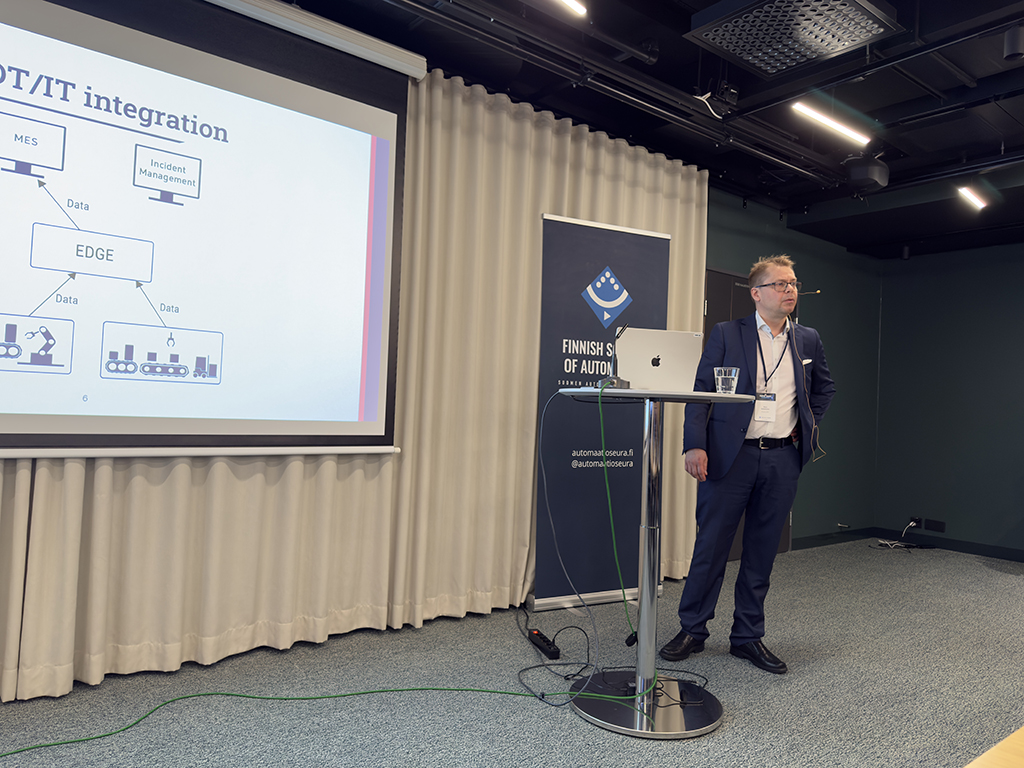

Jouni Aro
Chief Technology Officer