ProveIt! 2026 Conference | Dallas, Texas
Prosys OPC participated in the ProveIt! Conference 2026, which was held in Dallas, Texas on 16-20th of February. This event brought together Industry 4.0 vendors and end users where the goal was to demonstrate their solutions work in practice. Each vendor in the conference faced the same challenge, which they had to solve using their product, and present it live either on the stage or their stand.
The Prosys OPC ProveIT! Challenge recording is available on YouTube.
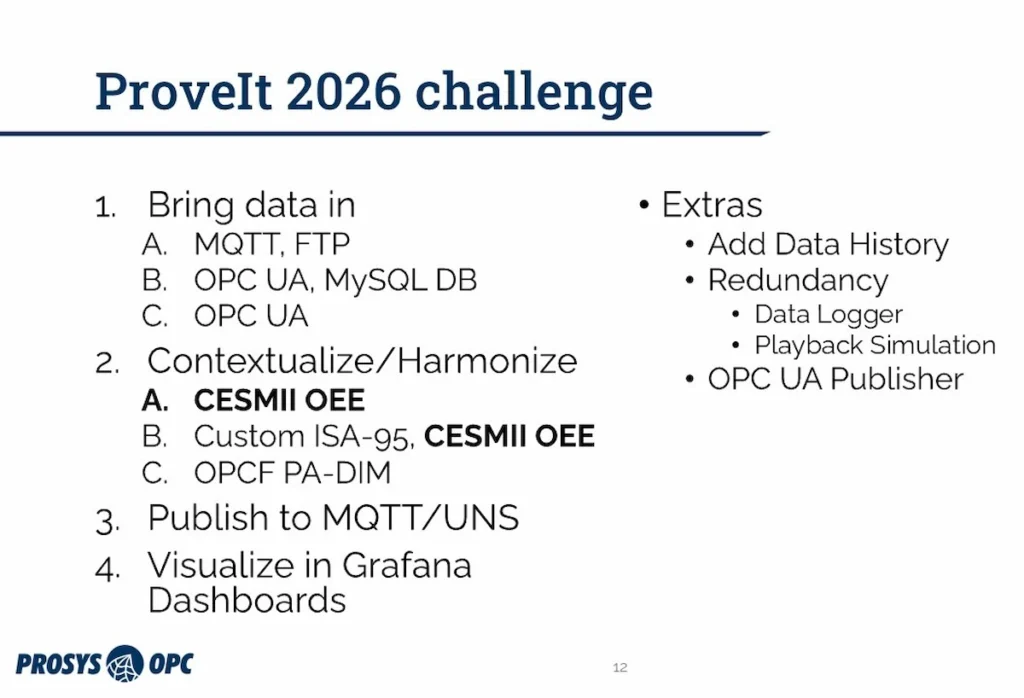
The challenge of the ProveIt! 2026 event was to demonstrate that the vendors’ product is capable of integrating into real industrial production systems. The production data was available in many different protocols, which were MQTT, OPC UA, SQL and FTP. This data did not always have a clear structure, format or context, which is why an important part of the challenge was to harmonize it using CESMII Smart Manufacturing Profiles. This ensured that the data always had a standardized structure, which made it much easier for other systems to utilize. The final step of the challenge was to publish this data back to the UNS, which was the event’s own HiveMQ broker.
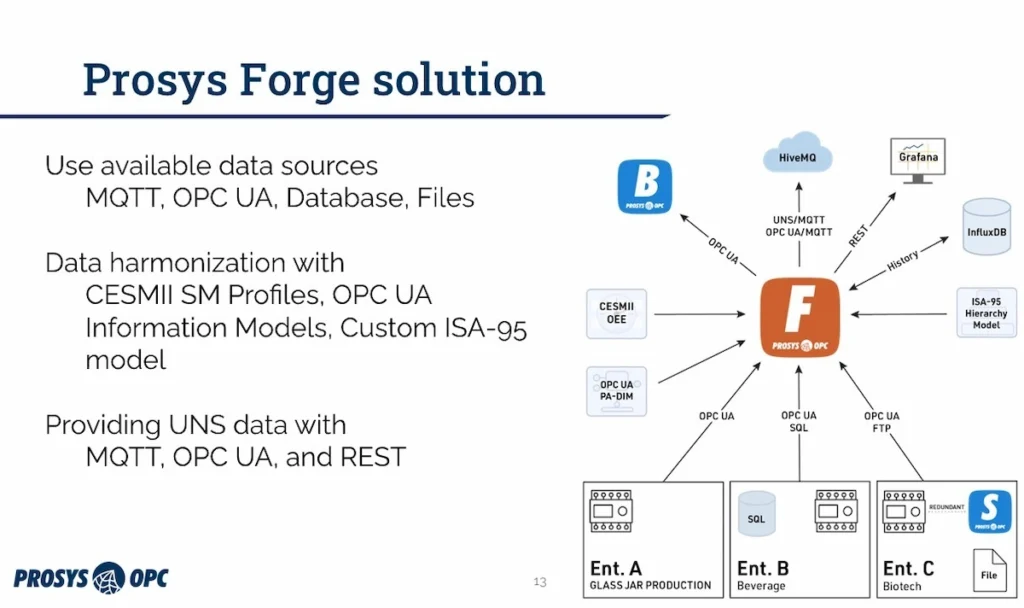
OPC UA Forge proved to be a well suited tool for this challenge. Firstly, it supports all the protocols for reading the process data. Secondly, CESMII SM Profiles are in fact OPC UA Information Models, which Forge utilizes. Finally, it is incredibly easy to publish Forge’s data back to UNS, or alternatively visualize it using in Grafana using its REST interface.
Forge is also able to store historical data, which ensures that no data is missed in the case it cannot be immediately passed forward. In addition, ProveIt’s OPC UA servers were often unstable, which is why we recorded the process data using Forge’s Data Logger module, and used our own product, OPC UA Simulation Server, to playback this data. After having this backup server available, it was defined redundant with ProveIt’s OPC UA server to ensure there was always a working data source.
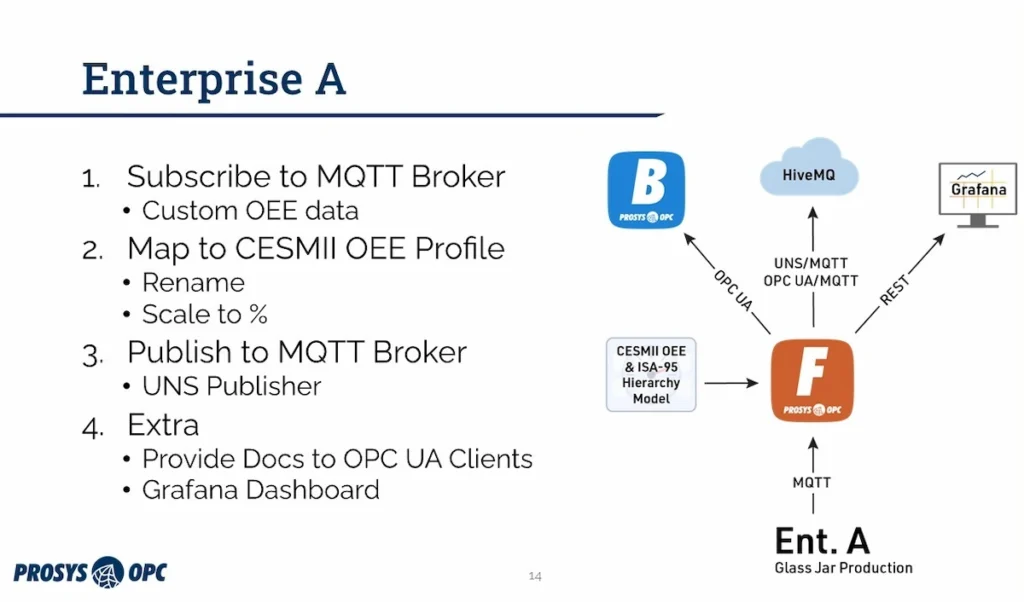
Enterprise A is a single-site glass jar manufacturing facility serving the food & beverage industry. Its data was available from an MQTT broker, from which Forge subscribed all OEE data. Using CESMII’s own OEE profile, the OEE data was harmonized into a standardized format. This data was then published back using Forge’s UNS Publisher. Additionally, the same data was available for both Grafana and OPC UA clients.
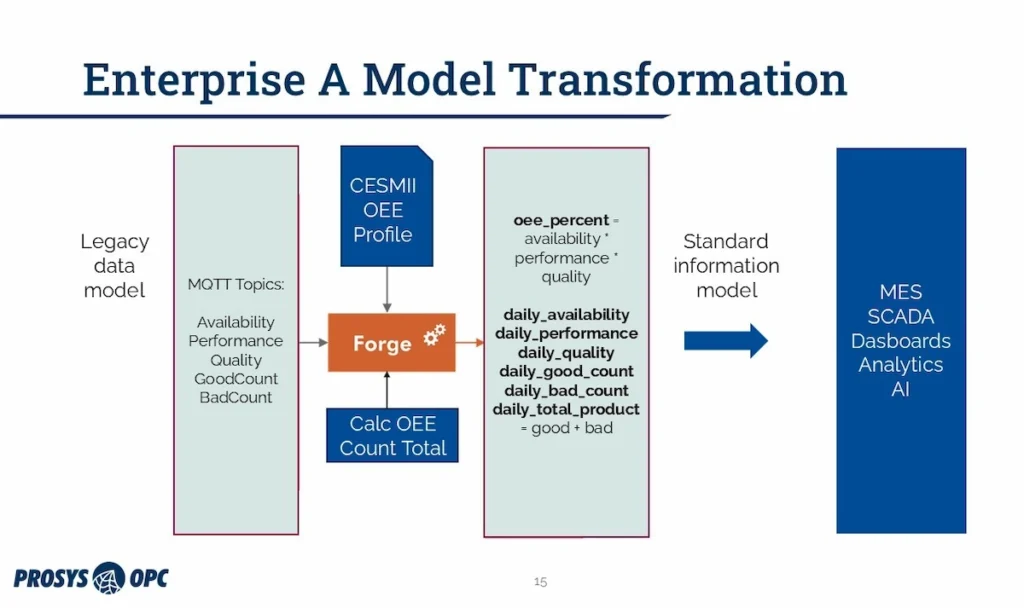
The OEE data published to the UNS differed slightly from the format that CESMII MS Profiles use. The model conversion was simple to do in Forge, as you only needed to import the model and map the data to it. Forge could also define business logic in the mapping by counting the sum of the good and bad products and mapping it to the total count.
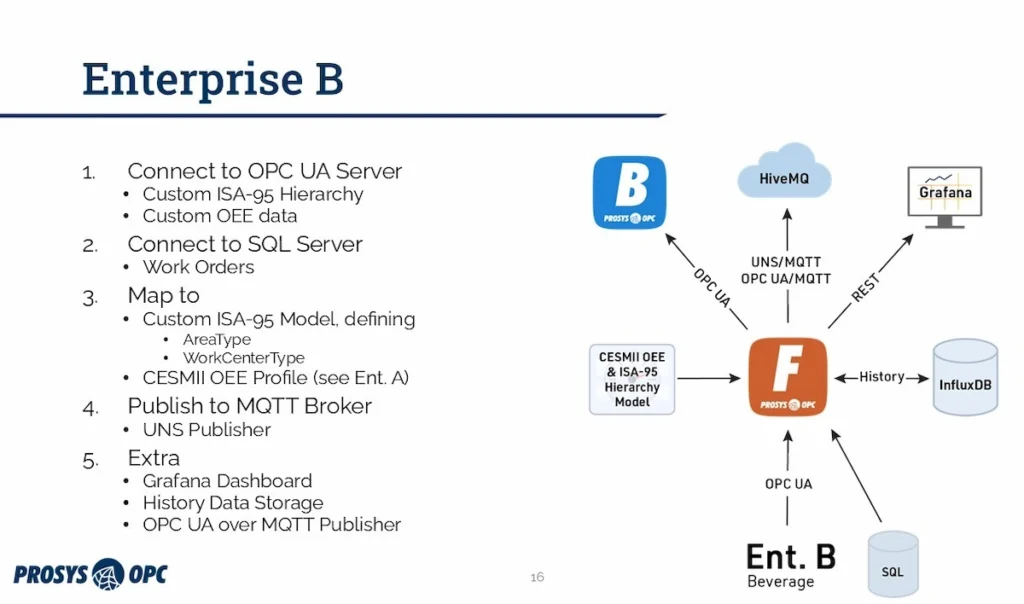
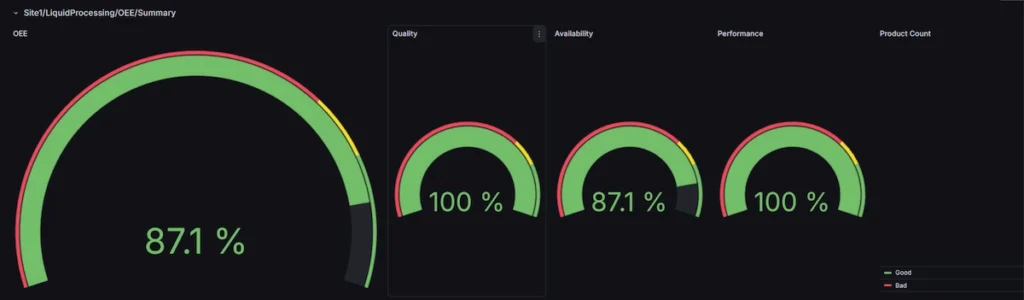
Enterprise B is a multi-site beverage bottling enterprise producing a variety of liquid consumer products for regional distribution. Forge was connected to its OPC UA server to receive the process data, and also to its SQL database to retrieve work orders. The data was harmonized using a custom ISA-95 model, as well as the same CESMII OEE model as with Enterprise A. The data was then published back to the MQTT broker, and was also available for Grafana and OPC UA clients. In the image below, we can see a Grafana dashboard that displays the OEE data in real-time.
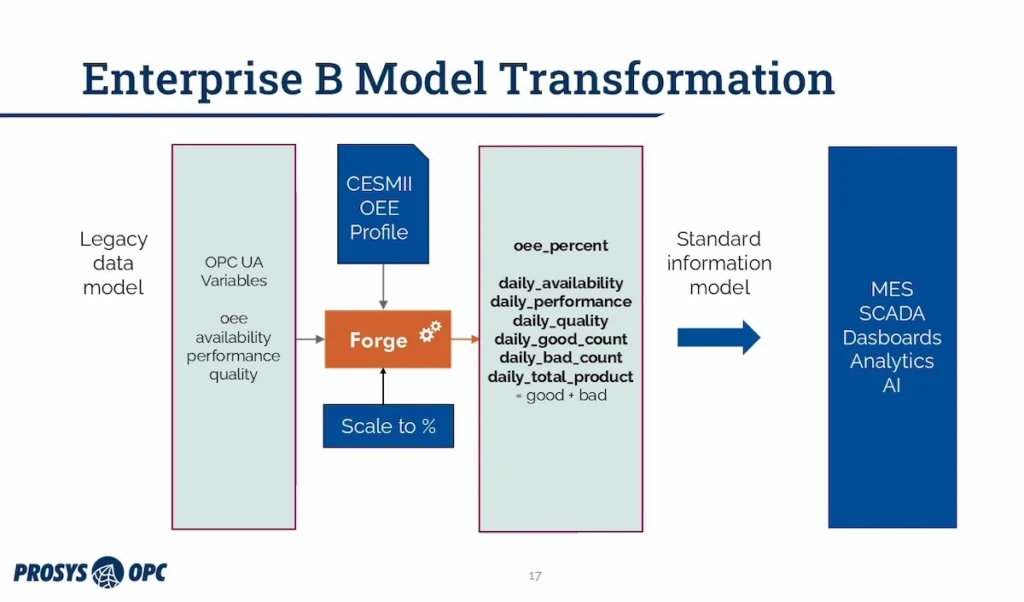
The OEE data of Enterprise B was harmonized using the same CESMII SM Profile for OEE as with Enterprise A. This time, the difference was that the data was provided by an OPC UA server instead of MQTT. The main takeaway here is that the OEE data ended up in the same harmonized model regardless of how it was originally provided or structured. With Forge’s advanced mapping feature, it was also easy to scale the OEE metrics to use percentages instead of decimal numbers.
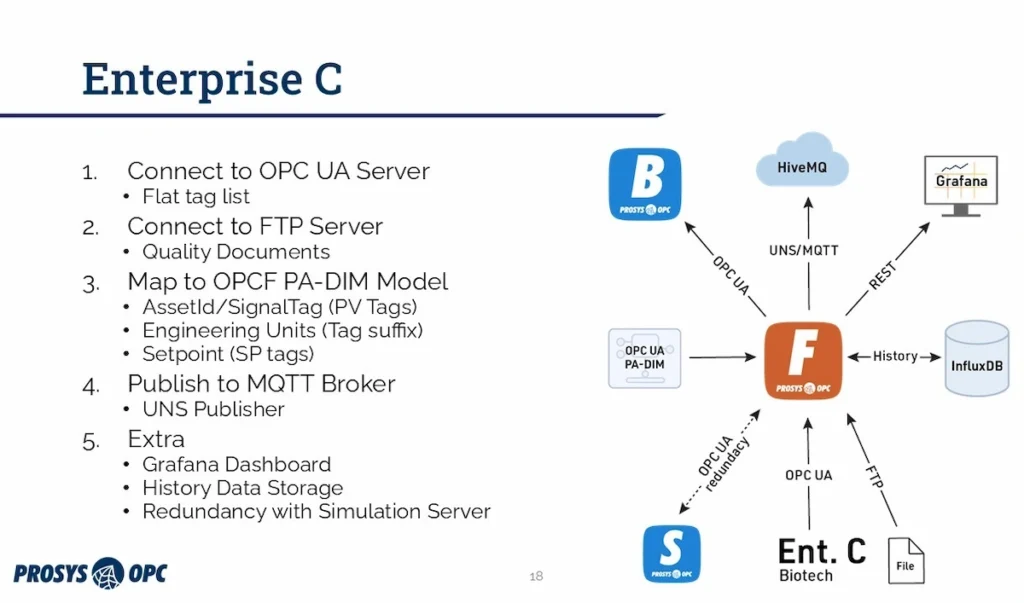
Enterprise C is a Pharmaceutical Process Automation plant that has all the data of the subprocesses as a flat hierarchy with the process and metadata on the same hierarchical level. For this reason, the data was in desperate need of harmonization. For this task, we used the PA-DIM model, which is a widely used model for process automation data. It provided a standardized format to represent the data of all devices, their measurements and metadata. Additionally, the batch reports and other paper documents related to the process were available in an FTP server as PDF files. We used Forge’s File module to retrieve these files and make them downloadable for OPC UA clients. Similarly to the other enterprises, the process data was sent to MQTT, Grafana and OPC UA clients.
In the end, Forge provided a comprehensive solution to the ProveIt! 2026 challenge. By supporting the most popular data protocols, and the superior modelling capabilities that comes with OPC UA, Forge is a great data integration tool for industrial production and automation systems. Additionally, Forge aims for all of this to be easily configurable. Many of the functionality used in this setup just a few clicks away, while creating and mapping large data models can be automated using Forge’s REST API if they follow a clear pattern. This resulted in the whole configuration of the setup to take an estimated of four days, which can be considered to be low given the amount of data sources and tags.

Artturi Korhonen
Software Engineer, Forge Team, Prosys OPC